What Does Volatility Mean in Slots?
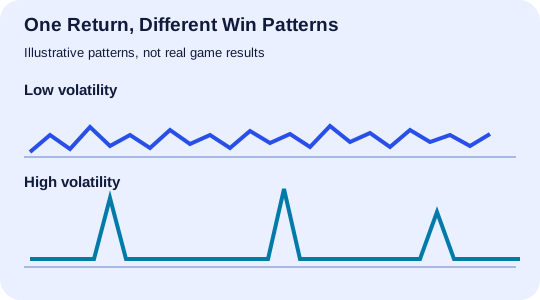
Volatility describes how a slot spreads its wins: small wins often or large wins rarely. A low volatility game pays something back on many spins, while a high volatility game can go a long stretch with little more than the odd stake-sized return. Providers also call it variance, and the two words mean the same thing.
It is not the same as RTP. RTP says how much of the stakes a game returns over a very long run, and volatility says how unevenly that return arrives. Two slots can both show 96 per cent and still behave very differently on a £20 budget. The guide to RTP covers the first half of that pairing.
Two games can share an RTP and still ride differently. Both games return 96% in the long run; one pays small amounts often, the other pays large amounts rarely.
Slot machine volatility comes from the maths built into the game: the paytable, the number of symbols on each reel and how much of the return is held back for bonus features. A game that keeps most of its return in one feature has to pay very little between those features. That trade is the whole idea, and it is fixed when the game is designed, not adjusted while you play.
Same RTP, Different Journeys
Each panel plays 8 imaginary sessions of 200 spins on a slot that returns 96% over the long run. Balances start at 100 units and every spin stakes 1 unit. Only how the returns are spread changes.
This is a simulation of a simple payout model, not any real slot. The line across each panel marks the starting balance; a path that touches the bottom has run out. Sessions of the same game can end anywhere in this spread. Please gamble responsibly. GambleAware.org 18+
What Does High Volatility Mean in Slots?
High volatility means most of the return sits in rare outcomes: a bonus round, a multiplier chain or a top prize, as on jackpot slots. Between those outcomes the balance tends to drift down in small steps. High volatility slots are built around that pattern, so a quiet spell is the design working as intended.
Hit frequency, the share of spins that return a win, is usually lower on these games, and many of the wins that do land are smaller than the stake. A short session can therefore end well below the starting balance even when the published RTP is high. The same session can also end far above it, but that is the less common result.
Dry spells are part of the design. A long run without a win does not make the next spin more likely to pay.
Each spin is decided by a random number generator at the moment you press the button, and earlier spins have no effect on it. That is why a slot is not due a win, whatever its label says. Volatility changes the shape of the results over many spins, not the odds of any single one.
How Do Low and High Volatility Slots Compare?
Low vs high volatility slots differ in how long a budget lasts and how big the occasional win can be. A low volatility game suits a long session at small stakes, with gentle swings in the balance. Starburst (3.1 of 10) sits at the low end of NetEnt’s range. Wins are frequent on such games, but most of them are small.
Medium volatility sits between the two, mixing small and mid-sized wins at a moderate pace, while Twin Spin (6.5 of 10) sits in the upper half of NetEnt’s range. High volatility slots sit at the other end: wins are rarer, the swings are sharper and a single feature can carry much of the return. None of the three returns more than the others in the long run, because the RTP is a separate figure.
Read the pair together. RTP tells you how much a game returns; volatility tells you how bumpy the road is.
Neither end is better, only different. A player who values a steady session will find the low end easier to follow, and a player who accepts long quiet stretches for the chance of a large feature may prefer the high end. Megaways slots have a guide of their own, and each individual game carries its own label, whatever category it belongs to.
Which Slots State Their Volatility, and How?
The table shows what the provider publishes for eleven well-known slots. RTP appears only where the provider’s own page states it, and the volatility column repeats the label exactly as written. No table can name the best high volatility slots for everyone, so this one does not rank them. Each of the individual slot reviews states the published volatility where a provider gives one.
| Slot | Provider | Published RTP | Provider’s volatility label |
|---|---|---|---|
| Jack Hammer | NetEnt | 96.96% | 5.9 of 10 (NetEnt) |
| Blood Suckers II | NetEnt | 96.94% | Low |
| Gonzo’s Quest | NetEnt | 95.97% | 6.7 of 10 (NetEnt) |
| Starburst | NetEnt | 96.08% | 3.1 of 10 (NetEnt) |
| Twin Spin | NetEnt | 96.55% | 6.5 of 10 (NetEnt) |
| Dead or Alive | NetEnt | 96.82% | High |
| Jack and the Beanstalk | NetEnt | 96.28% | 7.7 of 10 (NetEnt) |
| Vikings Go Berzerk | Yggdrasil | 96.1% | Medium-High |
| Le Bandit | Hacksaw Gaming | 96.34% (max setting) | 3 of 5 |
| Book of Ra Deluxe | Novomatic | 95.10% | 5 (Novomatic scale) |
| Big Bass Bonanza | Pragmatic Play | 96.71% | Medium |
The scales differ from one provider to the next. Novomatic uses a numbered scale where Book of Ra Deluxe scores 5, Hacksaw Gaming rates Le Bandit 3 of 5, and NetEnt’s game pages use a 0 to 10 scale, with Gonzo’s Quest rated at 6.7 of 10. A 3 on one scale is not a Medium on another, so labels compare reliably only inside a single provider’s range.
Several of these games have reviews of their own, among them Jack Hammer and Gonzo’s Quest, with layout and feature detail beside the facts above. Each provider’s label stands as written, so a game is only as high or low as its own page says.
How Can You Check a Slot’s Volatility Before You Play?
Checking takes a minute and uses only sources the provider controls. The steps below work for any slot at a UK-licensed site, and they show the version you are spinning.
- Open the game’s information screen. The rules or help page lists the RTP and, on many games, the volatility label.
- Read the provider’s own game page. NetEnt, Hacksaw Gaming, Yggdrasil and Novomatic publish a label or scale for most of their titles.
- Keep maximum win separate. A prize ceiling does not show how likely it is to land or how the rest of the returns are distributed.
- Check which RTP setting the site runs. Some games exist in several settings, and the casino chooses which one to offer.
Le Bandit lists a top prize of 10,000x the stake on a 3 of 5 scale, while Gonzo’s Quest lists 2,200x with a 6.7 of 10 rating. The prize ceilings do not establish equivalent volatility ratings, and the providers use different scales. If a provider publishes no rating, treat the volatility as unknown.
Volatility labels have no common definition, which means each label is the provider’s own. Independent test houses check a game’s maths before launch, but the words Low, Medium and High are not tied to a shared scale. Use the label as a guide to the style of the game, not as a promise about any session.
Are High Volatility Slots Suitable for a Small Budget?
A small budget meets high volatility slots with a real limitation: the quiet stretches can outlast the money. If the budget is £20 and the stake is £1 a spin, a feature that lands rarely may never arrive in the session. Lower stakes reduce the cost of each paid round; they do not make a feature due or guarantee that it will arrive.
UKGC rules cap the stake, not the swings. Online slots allow up to £5 a spin for players aged 25 and over and £2 a spin for ages 18 to 24, and those limits apply to each volatility level. A capped stake makes each spin smaller, but a high volatility game still pays unevenly within that cap.
- Decide the budget first. Set it as money you can afford to spend on entertainment, before opening any game.
- Set a deposit limit. UK-licensed sites must offer one, and it holds even if a session runs on.
- Choose the stake from the budget. Divide the budget by the number of spins you want, instead of starting from the maximum.
- Stop at the planned point. A losing run is not a reason to raise the stake or deposit again.
Reality checks, time-outs and GamStop are available at UK-licensed sites for anyone who wants a break or wants to stop. The safer gambling tools guide explains each tool and where to find free support, and help is available around the clock through the support services listed there.
How Well Do You Know Volatility?
Four questions check the main ideas of this guide. Pick an option to see whether you were right and why; your answers stay on this page and are not stored.
What Else Do Players Ask About Volatility?
Why Does the Same Volatility Label Differ Between Providers?
Each provider uses its own scale: Novomatic numbers its games, Hacksaw Gaming rates out of 5 and NetEnt out of 10, so a label compares reliably only inside one provider’s range. A 3 on one scale is not a Medium on another.
Does a High Volatility Slot Have a Lower RTP?
No, not as a rule. RTP and volatility are separate figures, so a game can pair a high label with a high RTP or the reverse. Check the information screen for the RTP of the version you are playing.
How Long Can a £20 Budget Last on a High Volatility Slot?
It depends on the stake and on when a feature lands. At £1 a spin, £20 buys 20 spins, and a rare feature may not arrive in that time; a lower stake gives more spins, though it does not make a feature due.
Can a Large Maximum Win Establish a Slot’s Volatility?
No. A maximum is a ceiling, while volatility describes the full spread of outcomes. A top-prize multiple alone does not establish its probability or how the rest of the paytable distributes returns.
Sources
- NetEnt, Gonzo’s Quest game page. netent.com
- Evolution (NetEnt), Jack Hammer game page. games.evolution.com
- NetEnt, Dead or Alive game page. netent.com
- NetEnt, Starburst game page. netent.com
- NetEnt, Twin Spin game page. netent.com
- NetEnt, Blood Suckers 2 game page. netent.com
- NetEnt, Jack and the Beanstalk game page. netent.com
- Yggdrasil: Vikings Go Berzerk game page. yggdrasilgaming.com
- Hacksaw Gaming: Le Bandit game page. hacksawgaming.com
- Novomatic: Book of Ra Deluxe game page. novomatic.com
- Pragmatic Play: Big Bass Bonanza game page. pragmaticplay.com
- Gambling Commission, online slots stake limit guidance (£5 per spin from age 25, £2 for ages 18 to 24). gamblingcommission.gov.uk